

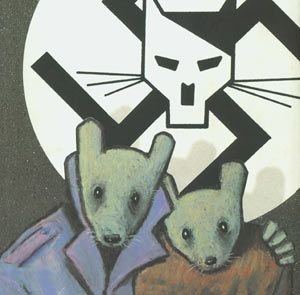
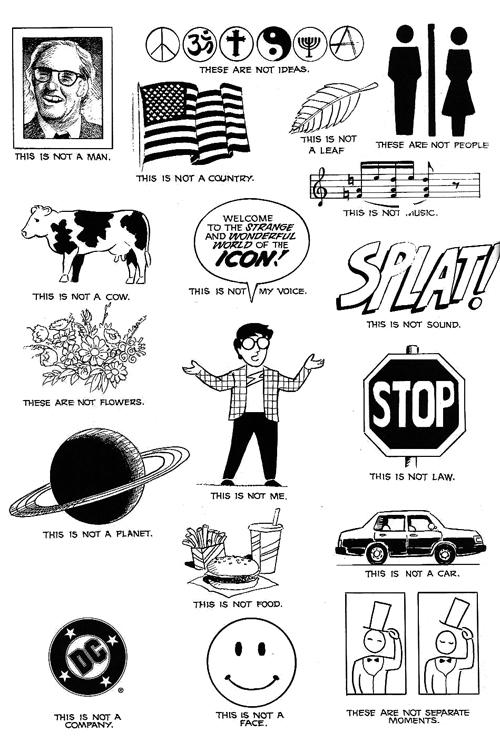
One of the most powerful -- and undoubtedly defining -- techniques that Art Spiegalman uses in Maus is instead of his characters being humans, they are represented by Mice (Jews), Cats (Nazis) and other various animals such as pigs. Scott McCloud forges very early on in his work Understanding Comics an understanding of the power of the icon. He argues that the icon lets the reading immerse themselves in the story. More importantly, the reader pays much less attention to the messenger and more attention to the message. Now that the humans are mice, one is able to insert themselves into a situation that many would before not been able. There are two major problems people face when reading about the Holocaust: one being the otherness of Europeans and specifically Jews and the other being how distanced we are from the events. To expound, a non-Jewish American will have trouble placing their family in the situation that Spiegalman's father experienced. It is not because people are anti-Semitic. It is simply they are not one of "us". The Jews of Europe during WWII are very much "the other." In making the Jews mice and allowing the audience to insert themselves and loved ones into these characters, this story is no longer a story of Jews and Germans, but a story of humans. Secondly, we are so distanced from the events of WWII and they have been so romanticized by pop culture over the last 70 years, that we have completely objectified the events. A survivor's tale could be casually referred to as "yet another Holocaust story" because of an over saturation with this type of narrative. Once again, the iconization -- i just invented that word if it isn't already one -- lends the story relevance.
Another thing that lends the story relevance is the gripping narrative on historical events. While almost all Holocaust pieces have a similar narrative, the presentation of this particular one is divided into two parts. While some would argue this fragments the narrative and may leech some of it's meaning, I would disagree. I believe that, while Maus lacks a clear beginning, middle and end, there is still a continuity as the story moves forward. Hayden White says in his paper The Content of Form: Narrative Discourse and Historical Representation, "[a]nd it would follow that the absence of narrative capacity or a refusal of narrative indicates an absense or refusal of meaning." Essentially he is saying without a narrative, historic events have no intrinsic meaning. The meaning lies in the story. Historic events mean something because of the stories we tell about them -- stories such as Maus.
So we see that Spiegalman's put together a touching and unique story. He made this story relevant by changing the way we look at an all-too-familiar historic event. Not to save the Holocaust was not a gripping, moving event and almost any survivor tale would be a worth narrative. However, a fresh look at the events providing the ability to insert ourselves into the situation via icons has been invaluable to this narrative and to me personally.


