11.16.2009

Far From Heaven: Blackness, Marginalizatoin and Washboard Abs

Far From Heaven rocked my world with Dennis Quaid’s washboard abs, the All-State guy’s soothing voice and of course Julian Moore with a haircut that just doesn’t work for her. I’m a very shallow movie watcher, this we know to be true. Although, I did, through sheer willpower, I made myself pay attention to two things in the film. The use of color and what the use of colors even means. I suppose really it is paying attention to one thing and then expanding on it, but I’m really reaching here.

(What are you talking about with colors? You do know those mushrooms that your roommate keeps in his desk are NOT for your pizza, right?)

First, the intentional use of different lighting filters in different sequences is very clear throughout the film. For example, when Captain Washboard Abs (Quaid but from now on known as CWA) first ventures into the gay-bar (is there a better word for that? Alternative Lifestyle Hangout? That is waaaaaay too long. I’m sticking with gay-bar…which sounds like a delicious German treat…goodness I’ve stumbled far from my original thought.) the whole room is lit by a green hue. This green hue returns when Julianne Moore finds CWA philandering in his office. (Also sidenote: philandering is a word I don’t use nearly enough.) This hue continues throughout the film and seems to represent a shame of sorts. Whenever a character is acting outside of the role that has been assigned to them by society, it appears. The blue hue is the other hue that appears multiple times throughout the film. We see it when a character (typically CWA) is in the dark, grappling with their role in the world.


(Alright, I’ll bite, so if these colors signify different things, what does the film itself say about roles?)


So Fanon talks in his piece “The Fact of Blackness” about how his blackness is viewed through a lens comparing it to whiteness. He talks about cannibalism and slavery for a while, but when he finally calms down with the histrionics and makes a point, he makes a valid one. CWA is just as marginalized as say All-State guy is. He would be viewed poorly and treated badly because of his homosexuality, but the difference is he is capable of hiding it. Fanon very obtusely compares his blackness to the plight of Jews throughout the world and while I hold contention with some of the things he said, his overall point his true. Blackness is not something that can be hidden. Furthermore, blackness has a role assigned with it
and when a black man acts outside of those roles, as All-State did, there is an outcry. Eventually, that outcry led to All-State’s removal .

Essentially, there are many marginalized groups. If you aren’t a white, protestant, wealthy male, you probably fall into one of them. However, only a few are very apparent -- as apparent as the light of the room in a scene or the color of one’s skin.


The most important question this film made me ask is two-fold: how many situps does Dennis Quaid do a day and why wasn’t he cast as King Leonidus in 300?

Seriously. I want to meet this man's trainer.

11.04.2009

Conversations With Myself: New Blag Format to Keep It Fun (For Me, Not You)

Sup blag.

(Sup.)

Good to see you again. Boy, do I have a doozie for you today. I got to watch a lady be hanged.

(Sounds terrible.)

Oh yeah, I openly wept and hid under the covers for like 45 minutes. Don't tell anyone.

(Secret is safe here, chief.)

Thanks buddy. Wanna hear about it?

(Not really, but I'm going wager that you'll tell me about it anyway.)

Bingo. You just get me, blag.

I Can't See S*@t: Dancer in the Dark, Blindness and Alienation


I'll be honest, I've read a lot of Marx. No, it is not because I'm a communist revolutionary. More out of curiousity. Growing up under possibly the most Republican (they're calling themselves Libertarians now, get with the times) parents to ever exist, one begins to wonder why everything they dislike is "Communist", "Socialist" or "Marxist." So I'll preface this with saying, I was pumped to do some stuff on Marx. Also, Bjork has always topped out my weird-o-meter. (Like that time she wore a swan as a dress?) Exactly like that. Dancer in the Dark did not disappoint on the weird scale. The whole film is about the alienation of Bjork's character. (Didn't Bjork alienate herself by being weird and from a part of the world that no one cares about? What even is a fjord?) No, alienated in the way Marx spoke about in his writing. The alienation of the worker, of labor. (You're gonna make me ask it, aren't you?) Absolutely, that is why I keep you around.

(In what ways was Bjork's character Selma alienated and how does it parallel Marx?)

The most obvious answer to this of course is her place in the world. She was a worker doing manual labor in a plant, living on someone else's land in their trailer. This is just in content alone. How does the director represent her alienation? Her blindness of course. This is the most obvious symbol in the entire film. (Not obvious to the point of being lazy I hope.) Nope, it is well executed. Her blindness is representative of her alienation. (You keep saying Marx's alienation, just assuming I know what it is. You always do this. This is why you have no friends.) Fine, I'll explain it, quickly and simply. (If you did it any other way, I'd stop listening.)

"Labor produces not only commodities: it produces itself and the worker as a commodity." (What in the heck does that mean?) By making labor something that can be bought, something that has value, the worker is "objectificated." (That's not a word.) Yes it is. (Then why is there a red line below it.) Stop, just let me finish. "The more objects the worker produces the fewer he can possess and the more he falls under the dominion of his product, capital." Essentially, the worker eventually becomes nothing more than his product. The worker finds him or herself in the product. These workers live to work. They are no longer human. They are alienated and most importantly, they have no idea this is happening. They are blind to this process. Blind to the power over them. (Oh I get it. So she is blind to her dependence on the product.) I just said that. (No you didn't.) Whatever. It is a bit deeper than that. The worker eventually realizes their work is not theirs but belongs to someone else. That is where the alienation stems.

(Got it) No you don't. (But if I say I do, you'll move on to the important stuff.) True. So now that we're talking about Selma again, that is her blindness: her alienation and dehumanization. The most important part of the blindness: it is genetic and will be passed on to her son. (Oh sad.) Her work all goes to her saving for her son to recieve surgery to avoid the blindness. This is the same as a worker spending 60 hours a week in a factory trying to keep from perpetually having their offspring be int he same place, alienated.

(So I guess my next question is: did the film itself alienate the audience? because this film sounds pretty brutal.)

That is actually a point of contention in my class. (A simple yes or no would've been better.) It isn't that simple though. (It never is.) The audience never actually connects with the character of Selma. She is too awkward and strange. (Just like Bjork. Bjork as Bjork, brilliant!) The argument is made that since the audience is estranged from Selma, we are estranged from the situation. Always the contrarian, I say this is not the case. (You would.) The film does a couple things that actually make the audience more connected to the situation, even though they are disconnected from Selma. (Oh God, a list...) 1. The handy-cam filming makes one feel as though they are baring witness to the events. The camera is not intended to be a view from any particular character, but it does give the feel that you are standing there when she is hanged, when she walks home on the tracks, when she day dreams int eh factory. 2. The candid moments. The moments when Selma does not think anyone is watching her. For example, when she walks home, kicking the tracks to know where they are. Or when she places her finger in her water glass to know when it is almost full. Little things like these bring the audience closer to the events and give them a sort of authenticity. (No three?) No three. I said a couple. (I always forget, a couple is two, a few is three or four and many...oh I'll never get your ambiguous crap.)

So, wrapping it up (finally!), the blindness plays a key role in not only demonstrating Marx's Alienation, but also in bringing the audience closer to the situation, even if this distances ourselves from Selma. (WOO!)


10.21.2009

Stop Staring. Its Creepy: Mulvey and the Rear Window


Remember when being a peeping tom wasn’t super creepy? Neither do I. In fact, I still remember the first time my mother had me watch The Rear Window. I was about twelve or thirteen and we had watch Birds the night before. Or maybe it was North by Northwest. I can’t remember. The point is, she assured me it was just as genius as the movie the night before. However, as a child, I remember being immersed in the film but having inkling that there was something wrong with what our protagonist was embarking on. Yes, he had good intention, but he sure was being a creeper about it. More importantly, he seemed to enjoy watching these people. Mulvey would of course have a lot to say about young Bob’s reaction to this. She would use cool words like scopophilia (I KNEW that one was going to get a red line,) and reference Freud a lot. So instead of dancing around it, let’s dive right into this.
Scopophilia is defined as pleasure in looking. I will from here on probably refer to it as “enjoying looking at stuff” because let’s be honest, we all like looking at stuff and we’re kind of scopophiliacs (another red line!).  So what would Mulvey say about the Rear Window and specifically how Jeffries setting affects his actions? Mulvey almost directly addresses this by saying “the extreme contrast between the darkness in the auditorium (which isolates the spectators from one another) and the brilliance of the shifting patterns of light and shade on the screen helps promote the illusion of voyeuristic separation” (382). Obviously this quote refers to the act of “looking at stuff” by the audience and not the characters in the film, but the gaze of Jeffries is just as important as gaze of the audience. Jeffries is almost always shrouded in darkness throughout the film and at some points even escapes to the darkness to achieve this separation from the object he is watching. Young Bob was separated from Jeffries as well, in the darkness of his living room and we as a class we separated as well. Essentially,  we were scopophiliacs of a scopophiliac (scopophiliac^2).
                This effect is even apparent when Jeffries is gazing at Grace Kelly (what was her name? She is always Grace Kelly to me, whatever.) We see this whenever she enters, as he gazes at her. The light-contrast is very apparent when the detective is visiting. He notices Lisa’s (Lisa, that was it!) night things on the counter and gazes at her shadow on the ceiling, with the light behind her and them in near darkness. The detective was separated just as Jeffries was separated from Miss Torso, Lonelyhearts and Mr. Thorwald.
                The way Jeffries gazes at the different sexes (Torso, Lonelyhearts and Lisa v. Thorwald) are starkly different as well. How would Mulvey compare Jeffries gazes toward women versus toward men?


            Also, Grace Kelly was a fox. Wait, did I just do what Mulvey said we do?

 Mulvey says, “please in looking has been split between active/male and passive/female” (383). This seems to be very true in the rear window. Jeffries watches Torso and Lonelyhearts with a sense of curiousity, seeing them as objects. He watches as Lonelyhearts circles the drain and as Torso…does Torso-y things. He even watches his girlfriend Lisa with a passive eye, as she is something to watch. All of these examples, they are never treated as an active way to advance the story but as something sexual and erotic (best example of course being Torso and Lisa.) Thorwald on the other hand is that of spectacle and advances the plot. In fact, the act of watching Thorwald is the major driving point of the plot.
                Mulvey would say the reason for all of this is for the audience to identify with the man (which they do) and to objectify the women (which it does in some but not all cases, ie. Lonelyhearts) and to her is proof of Freudian attitudes built into the audience (most involving castration and other delightful topics). While Mulvey’s interpretation is interesting and definitely merits the above observation, it is incomplete, but that isn’t the point of this blog, now is it?
Move along, nothing to see here. Stop staring. It’s creepy.

9.23.2009

Awwwwwwwwkward - The Creation of Tension in Jimmy Corrigan and Sleepwalk

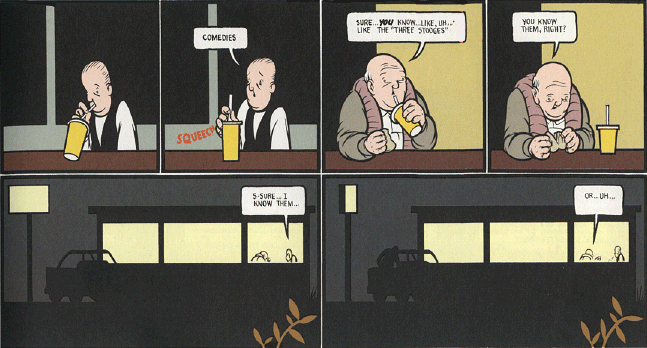
Not too long ago, I was saddled up at a bar, silently drinking a pint. I was meeting a friend, but arrived a little early. A beer by myself seemed like the best way to shake another long day at the office. All I wanted was to be left alone to wonder how at such a young age, I was spending so much time at a desk or at a bar. In doing so, I did not notice another patron pull up beside me and order a drink. Taking me by surprise, the mystery patron made an innocuous comment about the bartender. I do not remember what he said to me, for I turned to him to respond and sat face to face with a full-grown version of the child who had ridiculed, beaten and harassed me through childhood. Immediately, he realized who I was and I realized who he was. We both sat stunned, staring at each others, mouths agape, both of us struggling to make words, and instead were, as my mother said when we were children, "catching flies." This moment carried on for longer than it could have in actuality occurred. Eventually, overcome with the awkwardness of the moment, my former assailant received his drink and simply walked to the other end of the bar. No words were exchanged, nor would any be exchanged. Shared between us was merely an awkward moment, mouths hanging wide open, staring at each other in disbelief.

Chris Ware's Jimmy Corrigan: The Smartest Kid on Earth would work well as an in depth study on awkward moments such as that. While speaking with other students, words tossed around to describe the feel of the book were "awkward," "uncomfortable," and "tense." In Adrian Tomine's Sleepwalk, the same thing can be said for almost every story.

What techniques do Tomine and Ware use to create this tension in their works?


The character is off-the-charts awkward to begin with in Jimmy Corrigan. Jimmy is in Ware's words, "emotionally impaired." He spends a substantial amount of time day dreaming, staring off into space, not making eye contact with people and just being generally awkward.  How is this illustrated about Jimmy? First, other than Jimmy's father, grandfather and Amy, the reader never sees another person's face. This accomplished a few things. One, it isolates our characters. More importantly though, we see how little Jimmy notices other characters in this book. His day dreams and his anxieties get the better of him repeatedly. Jimmy actively avoids human interaction with everyone. When forced to interact with people, Jimmy is tenative and many long moments can pass before he responds, if he responds at all. Ware does an excellent job of illustrating this with "silent" panels. McCloud talks about how a panel void of dialog or narration can be used to show a passage of time. Through the text, there are examples of little to nothing being said between two characters over a series of many panels. The more panels, the more time the reader is to assume has passed.


An identical tactic is put into use in Tomine's Sleepwalk. Each character has silent frame moments. We draw the same closure. Time passes, words are not exchanged. Few words, spread over many panels indicates that awkward conversation we've all had. Long pauses between exchanges are filled with looming silence. Each vignette features a emotionally dysfunctional protagonist which can be seen to be more dysfunctional through these techniques.

What are you getting at Mr. Hotshot College Student? How does making the reader uncomfortable lend anything to the work (or more importantly, does the protagonist being awkward actually achieve tension?) What is the end result of these characters "emotional dysfunction," "awkwardness," and "tension?" Whatever happened to that old bully you ran into at the bar?

Whoa whoa whoa. Slow down, dear reader. One question at a time. The tension these panels create for the reader is very real. Not only is the character demonstrated to be awkward, the reader become awkward for them. Don't believe me? Reread the scene in Jimmy Corrigan when the doctor looks at Jimmy after he is hit by a car. I'll wait. Done? It made you squirm a little, didn't it? The end result of all this tension is in each story, these characters being utterly alone. Each Sleepwalk story and the Jimmy Corrigan story the characters are left alone because of their crippling awkwardness. Many of these seem like possibly autobiographic gestures about loneliness.

And that bully, well I was told by a mutual friend that he married recently. Also, they informed me that she cheats on him....a lot. Oh sweet justice.


*I WILL PROOF READ THIS IN THE MORNING! SO IF YOU READ IT TONIGHT, TOUGH COOKIES!*

9.18.2009

The Endurance of Ideas


I'd like to first preface this by saying that I had a blog posted typed in word and then my computer screen decided it was feeling blue, quite literally. Now I am on my itty bitty tiny baby laptop, wringing cramps out of my hands as I attempt to type on this smurf sized keyboard. So please, feel my pain as I type.

What is the significance of V's mask and Dream's tools in the two texts?


Between V For Vendetta and Preludes and Noctures, there is an overarching theme: the theme of ideas being enduring and powerful. In V for Vendetta, the idea of anarchy -- and freedom through it -- is an idea championed by the stories antihero, V. For many reasons, the author never gives V a real name and we never see his real face. V says, "you must discover whose face lies behind this mask but you must never know my face." Implying that V was not a man, V was an idea, a different face entirely. When V is fatally wounded, he says his iconic line, "Did you think to kill me? There's no flesh or blood within this cloak to kill. There's only an idea. Ideas are bullet-proof." Once again, cementing the idea that V would continue to live on. We see this come to be as Evey eventually dons the mask and becomes V, even taking on another disciple. V, as an idea, was enduring and immortal and would make a difference long after his death.

We see a very similar endurance of ideas in the Sandman. With all the stock the Sandman had put in his material tools, it was only with the destruction of one of these tools, he regained all the power he had lost. The idea of Dream was more powerful than the objects and tools he used. Both the mask which V and Evey don and the tools that Dream is so dependent on represent the power of ideas.

Why is the endurance of ideas important in these texts?


Ideas serve very difference purposes in each text. In V for Vendetta, it is painted with a much broader brush while talking about the meaning of freedom, order, anarchy, control, fascism and so on. We are led to accept V's almost Marxist definitions of freedom, but we do see the governments conflicting ideas of the same kind of ideas. Even those ideas, you see had staying power in the finals pages as some people still clung to the ideas. Therefore, ideas can create change (or deny it) more effectively that one man. In Sandman, the ideas are more personal. The concept of dream being more powerful than objects is represented by the destruction of Dream's amulet. This is more about the idea of dream himself being more powerful than the objects he seeks.

9.02.2009

Maus and Men: The Power of Icons and the Narrative Form

The stirring story of a man relaying his time as a Jew in Europe in the late 30's and early 40's would normally be a compelling enough tale. Add to that tale his time spent in what is widely considered the most brutal of all the concentration camps of the time and for most people the tale would start to seem familiar, if not histrionic. However, the graphic novel Maus takes events from human history and makes them seem fresh through a few very simple techniques. The story manages to relate to the reader through the use of icons and a, despite it's flaws, very strong narrative. Exploring techniques discussed by Scott McCloud and Hayden White, one can shed some light on why this story works and how without a few devices would not be nearly as effective or affecting.


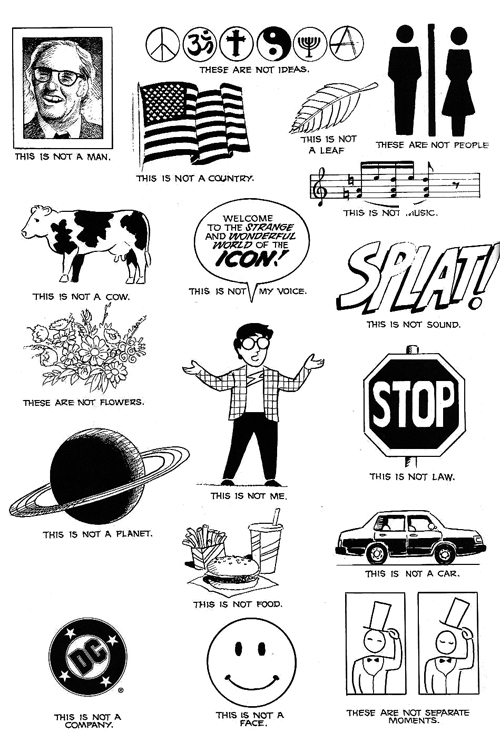
One of the most powerful -- and undoubtedly defining -- techniques that Art Spiegalman uses in Maus is instead of his characters being humans, they are represented by Mice (Jews), Cats (Nazis) and other various animals such as pigs. Scott McCloud forges very early on in his work Understanding Comics an understanding of the power of the icon. He argues that the icon lets the reading immerse themselves in the story. More importantly, the reader pays much less attention to the messenger and more attention to the message. Now that the humans are mice, one is able to insert themselves into a situation that many would before not been able. There are two major problems people face when reading about the Holocaust: one being the otherness of Europeans and specifically Jews and the other being how distanced we are from the events. To expound, a non-Jewish American will have trouble placing their family in the situation that Spiegalman's father experienced. It is not because people are anti-Semitic. It is simply they are not one of "us". The Jews of Europe during WWII are very much "the other." In making the Jews mice and allowing the audience to insert themselves and loved ones into these characters, this story is no longer a story of Jews and Germans, but a story of humans. Secondly, we are so distanced from the events of WWII and they have been so romanticized by pop culture over the last 70 years, that we have completely objectified the events. A survivor's tale could be casually referred to as "yet another Holocaust story" because of an over saturation with this type of narrative. Once again, the iconization -- i just invented that word if it isn't already one -- lends the story relevance.

Another thing that lends the story relevance is the gripping narrative on historical events. While almost all Holocaust pieces have a similar narrative, the presentation of this particular one is divided into two parts. While some would argue this fragments the narrative and may leech some of it's meaning, I would disagree. I believe that, while Maus lacks a clear beginning, middle and end, there is still a continuity as the story moves forward. Hayden White says in his paper The Content of Form: Narrative Discourse and Historical Representation, "[a]nd it would follow that the absence of narrative capacity or a refusal of narrative indicates an absense or refusal of meaning." Essentially he is saying without a narrative, historic events have no intrinsic meaning. The meaning lies in the story. Historic events mean something because of the stories we tell about them -- stories such as Maus.

So we see that Spiegalman's put together a touching and unique story. He made this story relevant by changing the way we look at an all-too-familiar historic event. Not to save the Holocaust was not a gripping, moving event and almost any survivor tale would be a worth narrative. However, a fresh look at the events providing the ability to insert ourselves into the situation via icons has been invaluable to this narrative and to me personally.

9.01.2009

Maus + White

WAAAAAAAAAH?

I am making an outline. I will put words here. This is a placeholder. In the meantime here is a dog playing a sprinkler: